Bring me a real problem and I will solve it in front of your room.
Most sessions about this technology end with a slide deck and a feeling. Mine end with a working thing. A short frame, then your people put their worst recurring task on the table, the room picks one, and it gets built live before anyone leaves. Your organization keeps it.
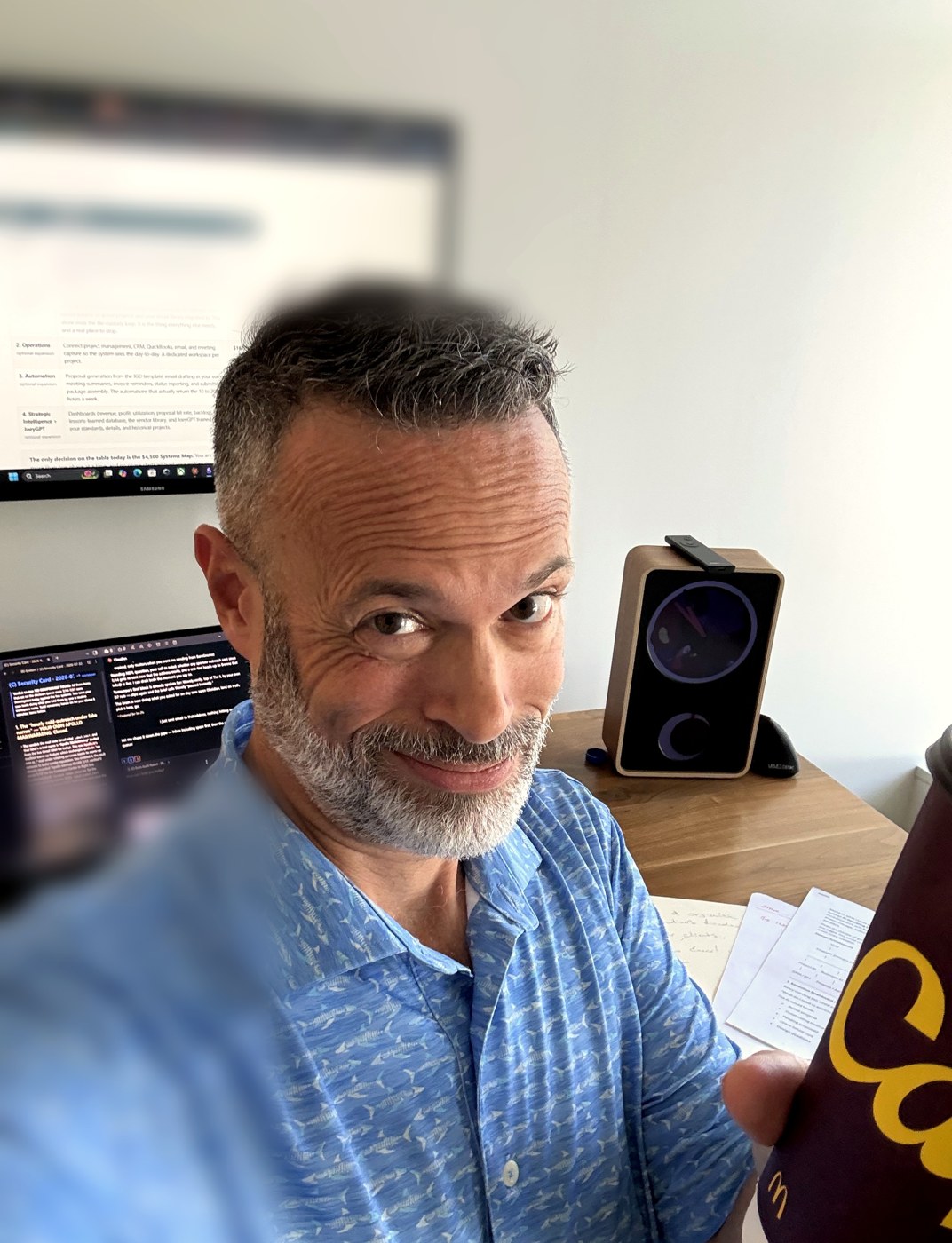 More than twenty years operating. The build happens in public, Fridays at 12:00 PM ET.
October
Two commissioned builds, one partnership, and a free room every Thursday.
The promise is time back, and there are four ways in. Pick up something already built and run with it. Have one built for your exact job. Get one built by commissioning it, partnering on it, or paying it over time. Or learn to build it yourself and stop needing me, which is the one I would rather you picked.
The October board holds two commissioned builds and one partnership. The partnership is filled by nomination and nobody can nominate themselves, so somebody has to put a name in. Everybody who describes a job gets a written quote back inside 48 hours, free, whether the board has room or not, and it is theirs to keep whether they ever hire me or not.
If you are here to book a room, this is the part worth knowing. The live build I run for your organization is the same thing I do in public every Friday at 12:00 PM Eastern on @2ndbrainway. You do not have to take my word for whether it holds a room. Come to a Thursday and watch one, then decide.
Or call. (904) 478-0440 reaches me, not a form.
The thesis
A room that learns something and a room that believes it can do something are two different rooms.
The first one nods, takes a photo of a slide, and goes back to work exactly as before. The second one goes back to work and changes something on Monday. The difference is not the content. It is whether anybody in that room watched a real problem, theirs, get solved in front of them by a person standing at the front with no net.
So I build live. Not a canned demonstration prepared the night before. The problem comes out of the room, and the thing that gets made is handed to the people who named it. That is the whole method, and it is why the last twenty minutes of my sessions look nothing like the last twenty minutes of a talk.
THE ROOM LEAVES ABLE TO BUILD THE NEXT ONE WITHOUT ME.
An operator, not a career speaker.
Everything below is checkable, and the last item is the one most people would leave off the page.
More than twenty years running the thing, not describing it
Founder of 2ndBrain, and of Wovely, a software product I designed and shipped. Before that, marketing, ecommerce and operations at Web.com, PCCA, Event Decor Direct, Versea Health and Savannah Bee Company. I speak from inside the job, which is why the questions after the session tend to be operational rather than philosophical.
I built the assembly line once already
Before Web.com was Web.com, it was Website Pros. There were about ten of us when I joined, and my job was to figure out how to build websites better, faster and stronger. What I ended up building was an assembly line: a repeatable production system for web development. It turned a small design team into a 120 person operation and helped carry the company into what became Web.com. More than twenty years later I am building the assembly line again, for a different technology. Same instinct, same method, new machine.
I have sat in the chair
I was a member of a Vistage peer advisory group in Texas. I know what that room is for, what it costs a member to give up a working day for it, and exactly how fast a chief executive stops listening to a speaker who is really there to sell something. I would rather be the session a chair recommends to the chair in the next city.
You can watch me work before you book me
Every Friday at 12:00 PM Eastern, in the 2ndBrain Way Interactive Workshop, I take one real task from one real business and handle it live, online, free. No card, no trial. If you want to know whether I can hold a room and produce something inside ninety minutes, do not take my word for it. Come to a session and watch, then decide.
New to the paid stage, and saying so
I am not going to show you a highlight reel of ballrooms. I have spent more than twenty years presenting to executive teams, leadership meetings and rooms full of employees as part of the job, and I am now offering that work to organizations outside my own. What I have instead is a standing session, first aired 27 August 2026. Come to a Thursday, watch a real problem from a real business get solved in front of a room, and book off what you saw rather than off a highlight reel. If what you need is a person who can walk into your building, take the problem your team names out loud, and hand back something that works before lunch is over, that is the offer.
The centrepiece
The live build.
This is the format everything else is arranged around, and it is the one I would rather you book. Ninety minutes. No prepared demonstration, no fake company, no sample data. Your room supplies the problem and I build the answer in front of it.
Twenty minutes on what actually changed, in plain speech, with the hype removed and the limits named out loud.
Everyone writes down the recurring task they most resent. They go on the board. This is usually the moment the room realises how much it shares.
The room picks one. Not me. If the choice is genuinely too big for the time, I say so on the spot and we take the second.
Screen up, narrated the whole way, including the parts that fail. People need to see the recovery more than they need to see the success.
The thing gets handed to the person who named the problem, along with the exact steps to rebuild it.
What it cost, what it did not solve, and what would have to be true for the room to do this without me.
Two ground rules I will not move on. Nothing sensitive goes on the screen, so we scope the candidate problems with you beforehand and agree what is off limits. And I do not sell from the platform. If your people want to talk afterward they know where to find me, and your chair or your organizer does not have to spend the last ten minutes apologising for a pitch.
Eighteen sessions across seven tracks.
A booker should get a menu rather than a single act. Pick a track, pick a length, and I will shape the specific session to the room. Anything here can be delivered in person or online, and most of them can be cut down to a lunch hour or opened out into a full day.
The differentiator. Something real gets made and handed over while the audience watches.
The flagship. The room names the recurring task that eats the most time and gets the least respect, votes on one, and watches it become a working tool before the session ends. No prepared demonstration and no sample data, which is exactly why it lands. The failures stay in, narrated, because watching somebody recover from a mistake is what convinces a skeptical person that they could do this too.
The same idea, except nobody watches. Laptops open, everyone builds their own. We start from the task each person actually resents rather than a made-up exercise, and I move around the room unblocking people one at a time. The point is not to finish a curriculum. The point is that every single person in that room has made a working thing with their own hands by the time they leave, which permanently changes what they believe is possible.
Shaped for a chief executive peer group. Every member arrives with one bottleneck from their own company. Three get built live across the session, chosen to be different enough that the whole board learns something from each, and the rest get scoped on paper with me while the room watches the reasoning. Members leave holding something rather than holding notes, which is the difference between a good speaker day and one a chair repeats.
For the people who have to decide, fund and defend it.
Before Web.com was Web.com, it was Website Pros, and the assembly line I built there turned a small design team into a 120 person operation. This is that story told as an operating argument rather than a war story: what a repeatable production system actually does to a business, why almost every company builds one by accident and then defends it, and why this technology is the same problem showing up again with a new face. It ends on the specific question a leadership team should be arguing about this quarter.
Not a strategy session, because most leadership teams already have more strategy than they can act on. Three decisions get made in the room and written down before anyone leaves: what this company will and will not put through these tools, who owns the answer when somebody asks, and which single process gets rebuilt first. I facilitate and I argue back. Nobody leaves with a homework assignment they will not do.
Every owner is being sold a subscription right now, and most of them cannot tell the difference between software they should buy, software they should build, and a problem they should simply stop having. This session gives them a test they can run on the next vendor who calls: what the thing actually replaces, what it costs over three years including the hours, what happens to the data when it ends, and the three conditions under which building it yourself is now genuinely cheaper.
For more than twenty years, custom internal software was something only companies above a certain size could justify. Small businesses got whatever the market happened to sell them and built the rest out of spreadsheets, group texts and one person who cannot take a vacation. That constraint just moved, and almost nobody has told the people it moved for. This is the session that tells them, without pretending the change is free or finished.
The rooms where the fear actually lives, and where the hours actually get lost.
Aimed straight at the thing the room is worried about and nobody has said out loud. We separate the robot work, the copying, the retyping, the chasing, the formatting, from the part of a job only a person can do, and we do it on their actual jobs rather than in the abstract. Handled honestly this is the most relieving hour a staff room has had in a year. Handled dishonestly it poisons a rollout, which is why I will not deliver it as a reassurance exercise for management.
Pick the process the team runs most often and likes least. We map it on the wall exactly as it really happens, including the undocumented step somebody invented in 2019, then rebuild it together and run it once before we finish. Teams consistently discover that the expensive part was never the software. It was the four handoffs nobody had ever drawn.
Work rarely dies inside a person’s job. It dies in the gap between two people, in the moment where somebody assumed somebody else had it. This session is about that gap: what a real trigger looks like, why a checklist beats a reminder, and how to build the one small automation that ends the question that starts with did anyone ever. Practical, unglamorous, and the fastest measurable win in most companies.
More than twenty years of my own job, handed over.
Most deals are not lost to a competitor. They are lost to the seventh follow-up that nobody sent, because the first six were the wrong message and everyone got tired. We build the chaser: the sequence, the rules that decide what goes out and when it stops, and the honest line between persistence and being the person whose emails get filtered. Built with the team, on their real pipeline, in the room.
Turning a name and a company into a briefed, specific first call in about four minutes, done live on the attendees’ own upcoming meetings. Includes the part most sessions skip: how to tell when the research is confidently wrong, and what a seller should never repeat out loud without checking. Sales floors tend to adopt this one the same week because the payoff arrives on the next call.
A different room with different manners. Sessions built for it rather than adapted to it.
I sat in one of these groups as a member, and the sessions I remember are the ones where the speaker respected what a day out of the business costs. This one uses the board the way it is meant to be used: each member states the decision they are avoiding, the room pressure-tests it, and I supply the operating reality on what is actually buildable, at what cost, on what timeline. My job is to keep the room honest about feasibility, not to be the expert at the front.
Every member of a peer board is being pitched the same promises right now by people whose incentive is the signature. This session teaches a board to interrogate that pitch as a group: the four questions that separate a real capability from a demonstration, what to ask for in a pilot, what a fair exit looks like, and the specific contract terms that quietly transfer their data. I have been on both sides of that table, which is the only reason this session is worth a board’s time.
Not every room is a company, and the household is where most people will meet this first.
The calendar nobody shares, the meal planning that collapses on Wednesday, the medication list for an aging parent that lives in one person’s head, the school paperwork that arrives as a photograph of a photograph. A household runs on the same failures a small business does, with worse tooling and higher stakes. We build one of these live, and it is usually the session where somebody in the back row goes quiet and then asks the best question of the day.
For parents, teachers and anybody advising somebody young about work. Written to be honest rather than comforting: what genuinely changed, what is being oversold, which habits still compound, and why the ability to define a problem precisely is about to be worth more than the ability to execute a defined one. No predictions I cannot defend, and no pretending that the advice of the last twenty years still applies unchanged.
When one session is not the right instrument, because the change has to survive contact with a normal week.
Ninety minutes a week for six weeks, with real work in between. Each week ends with a working piece rather than a lesson: capture, a morning brief that assembles itself, an inbox that triages itself, a follow-up chaser, a searchable memory of everything the person has decided. By week six they are not using somebody else’s system, they have built their own and they can extend it without me. Runs for a single company or for a mixed cohort.
One company, one cohort of its leaders and its two or three most capable operators, eight weeks. We pick three internal problems worth real money, and the company’s own people build the tools that solve them with me alongside rather than in front. It ends with a working handover and a written standard for what this organization will build itself from now on and what it will keep buying. The deliverable is capability, so my last day should be uneventful.
The catalog exists so a booker has something to point at, not to limit what can be delivered. If your organization has a specific problem, a specific audience or a specific week that none of the above quite fits, describe it on the form below. I would rather build the right session than sell an approximate one, and I will say plainly when I am not the right person for a room.
Pick the container, then we fill it.
A call with whoever owns the outcome. What the room is, what it is worried about, and what would make the day a success in their words.
The session, the length, the run of show and the fee, before anything is owed. No cost and no obligation to proceed.
For live builds and workshops: the candidate problems, and a written agreement on what is off limits on a shared screen.
I arrive early, test the display and the sound myself, and I do not sell from the platform.
Whatever got built, plus the rebuild steps, plus the recording where the room agreed to one. Sent within two business days.
One check in at thirty days to find out what actually stuck. It is the only way I get better at this, and it is free.
- A screen the whole room can read. Everything I do is on that screen. A projector I can plug into, or a large display, plus the ability to share sound if we are online.
- Network access that is not the guest wifi from 2016. A live build is live. If the connection is fragile, tell me in advance and I will bring my own.
- One person who knows where the bodies are buried. For workshops and builds, somebody from the organization who can answer how a process really works rather than how it is documented.
- Permission decided in advance. What may appear on a shared screen and what may not. I would rather have that conversation two weeks early than in front of an audience.
- An honest brief. If the room is skeptical, resistant or already burned by a bad rollout, that is useful information and it changes how I open. Nobody is served by a warm introduction to a cold room.
What it costs
Quoted in writing, before anything is owed.
Fees depend on the format, the length, the size of the room, travel, and how much you keep afterward. The number arrives in writing after a twenty minute call, alongside the outline, and you are free to walk away from both at no cost. Nothing is published as a headline figure here because a fee quoted without knowing the room is either too high for the small ones or too low for the hard ones.
Length and format. Travel and whether an overnight is involved. Room size and whether it is hands on. Whether you want the recording and the right to reuse it internally. And how many sessions, because a series is priced as a series.
The scoping call, the written outline, the run of show, whatever gets built in the room, the rebuild steps, and the thirty day follow up. Materials for attendees where the session has them.
Schools, libraries, churches, community groups and small nonprofits should say what they actually have. Some of those rooms I take at a reduced rate and some I take for nothing, decided case by case rather than by a published policy. The worst outcome is that the answer is not this year.
Ponte Vedra, Jacksonville and St. Augustine are a drive, so travel rarely shows up as a line at all. Anywhere else it is agreed in the outline before you commit. Online delivery is a real option, and for a live build it works better than most people expect.
Holding a date
Dates are held with a deposit that comes off the fee, and the balance is due after the session. The cancellation and reschedule terms are written into the outline before anything is owed, so you agree to them with the number in front of you rather than finding them later.
Card payment for engagements is not switched on yet. Dates are held by written agreement and invoiced, which changes nothing about the booking.
IN PERSON OR ONLINE · BASED IN NORTHEAST FLORIDA · QUOTED IN WRITING
Speaking, training and live builds
Tell me about the room.
Six answers and a sentence about the problem. I reply personally, and if I am not the right person for your room I will say so and try to point you at somebody who is.
I read every one of these myself and reply within one business day, usually sooner. If the date is tight, put the word urgent in a follow-up email to adam@2ndbrainconsulting.com and it will jump the queue.
Come watch before you book.
Every Friday at 12:00 PM Eastern, one real task from one real business, handled live and free. Next one is Friday at 12:00 PM ET. It is the same format I would bring to your stage, without the invoice.
Save a seat this ThursdayOr read where the method came from. The origin story is more than twenty years of doing this once already.
The path
- 01 · See one builtFree, Fridays at 12:00 PM ET
- 02 · Bring one taskThe One Task workshop, $500, 13 seats
- 03 · Get one builtA build call, free. One job, $0 to $3,500
- 04 · Keep it runningThe care plan, $200 a month
One path, four rungs, cheapest first on purpose. Start with See one built.
Save a free seat See the whole ladder with prices →